Showing posts with label bubble. Show all posts

16 August 2026

Lesson From Barack's Folly

When a group of crooks masquerading as bankers and investors crashes out, do not bail them out like Barack Obama did.

It is bad politics and worse policy. 

This applies even more to the Artificial Intelligence charlatans than it did to the 2008 banksters.

After Barack Obama surged to the White House in 2008, his administration was hobbled by the perception that it had rescued the bankers who had crashed the global economy, held nobody accountable for the destruction that was unleashed, and left ordinary people to fend for themselves. Current events may soon rhyme with that fateful episode.

Just like before, there is an overleveraged, underregulated sector at the heart of our economy that could cause devastating consequences should it hit a liquidity crunch. Perhaps the biggest difference is that this time, the executives and billionaires have learned from 2007, and are already looking to justify golden parachutes in advance. Progressives can learn from 2007, too.

A Tale of Two Bailouts

In 2008, the Republican Party was dead in the water. Weighed down by the Iraq War and the unfolding Great Recession, the party suffered what is to date its worst defeat of this century. The view that a new period of long-term dominance was dawning for Democrats became commonly accepted. Memories of 1933 and an enduring Democratic majority were plausibly relevant, as George “Katrina + Iraq + subprime” Bush could make a long-term electoral punching bag comparable to Herbert Hoover.

Obama’s winning coalition was handed a gift-wrapped opportunity to champion working people in their clash with Wall Street. Instead, influenced by neoliberals like Larry Summers and Tim Geithner, the Obama White House chose to arbitrarily constrain the size of the stimulus package and prioritize stabilizing Wall Street as the “responsible” path forward, with accountability for the crisis dismissed as “Old Testament” justice. There was only a single prosecution for triggering the greatest economic downturn of the century.

………

In short, the 2008 bailout was a political albatross around the establishment’s neck, seen as a rescue of the very rich and connected people who caused mass unemployment and foreclosures. Whoever was in power as this anger built would get singed by it.

The AI folks are incredibly unpopular now.  If the Democratic Party establishment (There is no Democratic Party establishment) forces the party to bail them out when (it is when, not if) the bubble pops, this could destroy the party on a level that makes the 2010 "Shellacking" look like a high tea.


17 November 2025

We Are Unbelievably Screwed


BTW, IG Stands for "Investment Grade"


Nope, no bubble here

It is beginning to look a lot like large language model artificial intelligence will be this generation's subprime mortgage backed securities. 

With even the Wall Street Journal describing the current borrowing to build AI infrastructure as a frenzy, it seems that we are overdue for a rather profound reckoning.

This bubble is if anything worse than the real estate bubble, because they are investing in a rapidly depreciating asset.

If you spend a billion dollars on Nvidia chips, in 5 years those chips will be worth less than 5% of that. (Probably much less)

People are literally burning money to purchase burning infrastructure. 

Not long ago, Blue Owl Capital was an upstart investment firm that lent money to midsize U.S. companies such as Sara Lee Frozen Bakery.

These days, the firm is financing massive data centers costing tens of billions of dollars for the likes of Meta and Oracle—a sign of just how quickly Wall Street has become the enabler of America’s artificial-intelligence boom.

Fund managers such as Blue Owl amassed trillions of dollars of investing firepower and have been hunting for big deals where they can put that money to work. They found slim pickings for years until a perfect match appeared in AI, which has provided a bigger target than anything in history due to the vast sums tech companies need to ramp up computing power.

And here comes the money quote:

………

Last week’s selloff in tech-related stocks and bonds marked some of the most serious warning signs that the frenzy could be overdone. But any worries on Wall Street about a possible investment bubble have largely been trumped by the fear of being left behind.

Speaking of scary quotes:

………

Then, last month, Blue Owl raised about $30 billion to build an AI data center for Meta in Louisiana, putting in $3 billion of its clients’ money and borrowing the rest. The deal included a provision, considered extraordinary on Wall Street, giving Blue Owl’s equity investment a debtlike guarantee in case the partnership falls apart—showing the new financial wizardry bankers are conjuring to meet AI’s ravenous financial demand.

 (all emphasis mine)

We are so going to be bailing out these morons in a few years. 

07 September 2025

Snollygosters Promoting Humbug

Rather unsurprisingly, an MIT study has shown that the use of LLM "Artificial Intelligence" do not generate any cost savings or productivity improvements in the vast majority of cases.

What, you mean the guys who gave us Razorfish, Pets.com, Netscape, AskJeeves.com, Lucent, etc. are selling us more money losing products where they make it up in volume. 

With AI software increasingly hogging the enterprise spotlight, companies and investors are spending like never before. In the first half of 2025, AI startups raised over $44 billion, more than all of 2024 combined. By the end of this year, a Goldman Sachs analysis estimates that total investments in AI will soar to almost $200 billion.

But all that money is, to put it gently, a reckless gamble. In the US at least, investors have essentially bet the farm on the idea that AI will soon lead to gains in labor productivity — the amount of goods and services workers are able to produce in a given time — that have never been seen in the history of humankind.

Despite the hype and bluster, that isn't happening. A new report by researchers at MIT, first covered by Fortune, found that a staggering 95 percent of attempts to incorporate generative AI into business so far are failing.

According to the report, titled "The GenAI Divide: State of AI in Business 2025," the MIT researchers found that only around 5 percent of businesses succeed at "rapid revenue acceleration," with the vast majority falling flat.

I am completely unsurprised.

10 July 2024

Oh, Snap!

When Goldman Sachs, the, "Great vampire squid wrapped around the face of humanity, relentlessly jamming its blood funnel into anything that smells like money, says that there is no money in it for them, there is no money in it for anyone.

Now Goldman Sachs is saying that there is no "there" there about artificial intelligence.

Given their predilections, as so eloquently stated early in cephalopod terms, this means that they don't even think that there is the opportunity to cheat the rubes out of their pocket change:

A week and a half ago, Goldman Sachs put out a 31-page-report (titled "Gen AI: Too Much Spend, Too Little Benefit?”) that includes some of the most damning literature on generative AI I've ever seen. And yes, that sound you hear is the slow deflation of the bubble I've been warning you about since March.

The report covers AI's productivity benefits (which Goldman remarks are likely limited), AI's returns (which are likely to be significantly more limited than anticipated), and AI's power demands (which are likely so significant that utility companies will have to spend nearly 40% more in the next three years to keep up with the demand from hyperscalers like Google and Microsoft).

This report is so significant because Goldman Sachs, like any investment bank, does not care about anyone's feelings unless doing so is profitable. It will gladly hype anything if it thinks it'll make a buck. Back in May, it was claimed that AI (not just generative AI) was "showing very positive signs of eventually boosting GDP and productivity," even though said report buried within it constant reminders that AI had yet to impact productivity growth, and states that only about 5% of companies report using generative AI in regular production.

(emphasis original) 

………

The reason I so agonizingly picked apart [go and read the original, the deep dive is informative and fun to read] this report is that if Goldman Sachs is saying this, things are very, very bad. It also directly attacks the specific hype-tactics of AI fanatics — the sense that generative AI will create new jobs (it hasn't in 18 months), the sense that costs will come down (they're haven’t, and there doesn't seem to be a path to them doing so in a way that matters), and that there's incredible demand for these products (there isn't, and there's no path to it existing).

This reminds me so much of the, "We lose money on every sale, but make it up in volume," era at the height of the dotcom boom.

Lots of people made lots of money for sh%$ that never had the remote prospect of working as a business, but the rest of us paid for that, and paid for that, and paid for that ………

23 June 2024

Gee, You Think?

Why yes, the headline, "Nvidia’s Ascent to Most Valuable Company Has Echoes of Dot-Com Boom," does reflect the feels.

They include comments from the former head of Cisco Systems, John Chambers, whose company briefly had the greatest market capitalization in the world in early 2000.

He says, "It's different this time," which are the 4 most alarming words in human history:

………

Nvidia’s chips have been the workhorses of the AI boom, essential tools in the creation of sophisticated AI systems that have captured the public’s imagination with their ability to produce cogent text, images and audio with minimal prompting.

The last time a big provider of computing infrastructure was the most valuable U.S. company was in March 2000, when networking-equipment company Cisco took that spot at the height of the dot-com boom.

Cisco was riding the wave of a different revolution—the internet—where its products powered that budding industry. Like Nvidia, Cisco also surpassed Microsoft to become the most valuable company.

John Chambers, who was chief executive of Cisco during the dot-com boom, said there are some parallels, but the dynamics of the AI revolution are different from previous ones such as the internet and cloud computing. Chambers, now a venture investor, has made big bets on AI in cybersecurity and other arenas.

“The implications in terms of the size of the market opportunity is that of the internet and cloud computing combined,” he said. “The speed of change is different, the size of the market is different, the stage when the most valuable company was reached is different.”

So let me get this straight, the former president of the formerly most overvalued company in the world, one who is now investing in the current most overvalued company in the world, is saying, "It's different this time."

Well, knock me over with a Cybertruck on autopilot, that's a surprise.  (Not)

25 May 2022

I’ve Heard This Song Before


Yeah, It Looks Like a Drop


Right off a cliff


Running into a wall


A primer in statistics


Real world consequences of the example


Spiking Mortgage Rate


Supply chain still f%$#ed

Just 14 years after the last housing crash, it looks like we are headed for another one.

Low end house sales have fallen off a cliff, interest rates are spiking, the housing inventory is spiking, as is time on the market.

Seems like old times, doesn't it?

Given that Wall Street is even more involved in real estate than it was before the last recession, I more than one Bear Stearns type collapses, followed by a multi-trillion dollar bailout, because, to quote (not) Tallyrand, they have learned nothing, and they have forgotten nothing:

Sales of new single-family houses in April plunged by 16.6% from March and by 26.9% from a year ago, to a seasonally adjusted annual rate of 591,000 houses, the lowest since lockdown April 2020, according to the Census Bureau today. Sales of new houses are registered when contracts are signed, not when deals close, and can serve as an early indicator of the overall housing market.

………

Unsold inventory of new houses spiked in a historic month-to-month leap of 34,000 houses, and by 127,000 houses from April last year, to 444,000 unsold houses, seasonally adjusted, the highest since May 2008.

Both, the month-to-month leap and the year-over-year leap were the largest leaps ever recorded, both in numbers of unsold houses and in percentages.

………

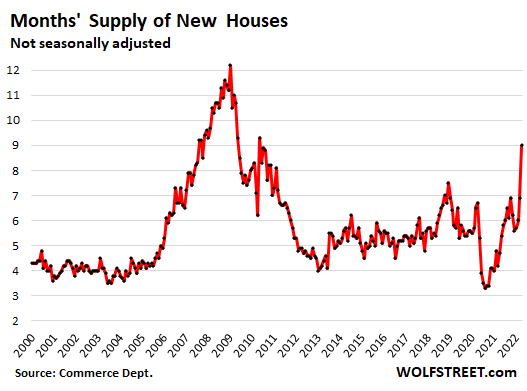
Supply of unsold new houses spiked in a historic month-to-month leap from an already high 6.9 months’ supply in March to a dizzying 9.0 months’ supply in April, having nearly doubled from a year ago:

The bottom fell out under $400,000. At the top end, things weren’t so bad: sales were flat year-over-year in the $400,000 to $750,000 range, though they fell on a month-to-month basis. But you cannot maintain a housing market by just selling to the wealthy.

The basically, the cheaper houses are first houses, and if you can't buy first houses, you cannot buy second houses, and this percolates up the chain.

There was a brief opportunity to break the power of parasitic finance in 2009, that opportunity was missed, and we are going to suffer from this failure again, and again, and again, and again.


11 May 2022

It's Inflation Day

Year over year inflation fell from 8.5% to 8.3%, which is still pretty damn high.

You have fragile international supply and transport chains breaking down, either from war or from things like the Shanghai lock-down, energy prices and food prices rising sharply, and a whole lot of profiteering from businesses that do not face meaningful competition.

The Federal Reserve, of course, is focused on driving down wages, even though they have been outpaced by corporate profits, because that's their thing:

U.S. inflation edged down to an 8.3% annual rate in April but remained close to the fastest pace in four decades as the economy continued to face upward price pressures.

The Labor Department’s consumer-price index reading last month marked the first drop for inflation in eight months, down from an 8.5% annual rate in March. The decline came primarily from a slight easing in April gasoline prices, which have since reached a new high. Broadly, the report offered little evidence that inflation was cooling.

………

On a monthly basis, the CPI rose a seasonally adjusted 0.3% last month after a 1.2% increase in March. However, the so-called core-price index—which excludes the often-volatile categories of food and energy—increased 0.6% on the month, a sharp pickup from March’s 0.3% gain, providing a sign of broad-based inflationary pressure.

Services prices, excluding energy, rose 0.7% in April from March, the fastest one-month increase since 1990.

April’s report offered a mixed picture for vehicle prices, which have risen sharply since last year due to demand and supply shortages. Used car and truck prices were up 22.7% on the year in April, down from a 35.3% rise in March. But new vehicle prices were up 13.2% from a year ago in April, the largest 12-month increase since 1949.

The Fed faces the tricky feat of tightening monetary policy enough to quell inflation and cool the economy without throttling growth and causing a recession. Central-bank officials on May 4 raised rates by half a percentage point, the biggest increase since 2000. 

It's not tricky at all for the Fed at all.  If they over-tighten and there is a recession, they are lauded for making the tough choices, and if they get it right, something that they have never really done, then they are lauded for threading the proverbial needle.

………

A steady pickup in housing costs, which account for nearly one-third of the CPI, is also adding to inflationary pressure. Both tenant rent and so-called owners’ equivalent rent, which estimates what homeowners would pay each month to rent their own home, rose 4.8% from a year earlier, a pace last seen in the late 1980s and early 1990s.

This is where it can get nasty.  Home sales are extremely sensitive to interest rates, people buy based on monthly payment, not price, and the demand for adjustable rate mortgages are surging, so it sounds like we are going to be partying like it;s 2009:

We can’t possibly be doing this again, right? From CNBC:

“Despite a slow start to this year’s spring home buying season, prospective buyers are showing some resiliency to higher rates. Purchase activity has now increased for two straight weeks,” said Joel Kan, an MBA economist, in a release. “More borrowers continue to utilize ARMs to combat higher rates. The share of ARMs increased to 11% of overall loans and to 19% by dollar volume.”

At the start of this year, when rates were still hovering near record lows, the ARM share was just 3% of all purchase applications. At 11% that is the highest share since March 2008.

………

You may recall that, back "in the early 2000s," almost nobody was talking about the danger of "poorly underwritten, interest-only ARMs," and the few people who pointed out that those "poorly underwritten, interest-only ARMs" were a nuclear time bomb at the heart of the world economy were utterly ignored, when they weren’t being ridiculed. The economy was sold as "robust," a veritable "boom." The fact that a chunk of it was built on Florida strippers who owned four houses was not widely known. In fact, the financial-services cowboys actively downplayed risks they absolutely knew were there. They knew the risks were there because they found ways to monetize those risks. From CBS News:

There's a useful term for such behavior -- it's called a "control fraud." That's how William Black, an economics and law prof at the University of Missouri-Kansas City, describes what happens when "seemingly legitimate entities," like companies, are used by executives to wrongly enrich themselves. In banking, such frauds typically involve lenders using bogus accounting to hide dodgy loans to uncreditworthy borrowers and deploying massive leverage to maximize gains.

These days, "Control Fraud" seems to describe the entirety of the US economy.

19 March 2021

Speaking of Leverage


Indeed, WTF


Increased leverage goeth before a fall
It appears that the use of margin trading, one of the things that triggered the stock market crash of 1929, is spiking, which is a pretty good indicator to me that we are headed to another market panic:

In the current craze that encompasses everything from sneakers and NFTs to stocks, where valuations don’t matter because of widespread certainty that valuations will be even greater in a few days, and where folks are chasing lottery-type returns, supported by the Fed’s interest rate repression and $3 trillion in asset purchases, and by the government’s trillions of dollars of handouts and bailouts – well, in this perfect world, there is a fly in the ointment: Vast amounts of leverage, including stock market leverage.

Margin debt – the amount that individuals and institutions borrow against their stock holdings as tracked by FINRA at its member brokerage firms – is just one indication of stock market leverage. But FINRA reports it monthly. Other types of stock market leverage are not reported at all, or are disclosed only piecemeal in SEC filings by brokers and banks that lend to their clients against their portfolios, such as Securities-Based Loans (SBLs). No one knows how much total stock market leverage there is. But margin debt shows the trend.

In February, margin debt jumped by another $15 billion to $813 billion, according to FINRA. Over the past four months, margin debt has soared by $154 billion, a historic surge to historic highs. Compared to February last year, margin debt has skyrocketed by $269 billion, or by nearly 50%, for another WTF sign that the zoo has gone nuts:

………

And it’s risky leverage for the borrower. It seems like risk-free leverage when stocks go up, but when your stocks do the unheard-of and tank below a certain level, your broker will ask you to put more cash into your account or sell stocks into the tanking market, whereby you then join the legions of forced sellers.

In the past, a big surge in margin balances tended to precede history-making stock market declines:

………

Leverage is the great accelerator of stock prices, on the way up, and on the way down. Purchasing stocks with borrowed money creates buying pressure, and prices rise, and rising prices increase the margin balances a portfolio can support, and this encourages more stock-buying on margin.

On the other hand, selling stocks to deal with margin calls adds more selling pressure to an already declining market. The more prices fall, the more selling pressure there is from frazzled forced sellers trying to deal with margin requirements.

When market correct, this is going to be very ugly.

H/t Naked Capitalism.

18 August 2020

Only in America

I came across two stories within minutes of each other, the first reported that FHA mortgage delinquencies have hit record levels, and the second story reveals that home builder confidence in the US has hit a record high. 

This is a recipe for disaster:
Federal Housing Administration mortgages -- the affordable path to homeownership for many first-time buyers, minorities and low-income Americans -- now have the highest delinquency rate in at least four decades.

The share of late FHA loans rose to almost 16% in the second quarter, up from about 9.7% in the previous three months and the highest level in records dating back to 1979, the Mortgage Bankers Association said Monday. The delinquency rate for conventional loans, by comparison, was 6.7%.

Millions of Americans stopped paying their mortgages after losing jobs in the coronavirus crisis. Those on the lower end of the income scale are most likely to have FHA loans, which allow borrowers with shaky credit to buy homes with small down payments.

For now, most of them are protected from foreclosure by the federal forbearance program, in which borrowers with pandemic-related hardships can delay payments for as much as a year without penalty. As of Aug. 9, about 3.6 million homeowners were in forbearance, representing 7.2% of loans, the MBA said in a separate report. The share has decreased for nine straight weeks.
Note that even though interest rates are low, Fannie Mae and Freddie Mac have implemented a
0.5-percentage-point “adverse market” fee to account for the increase risk of default, but home builders are confident.

My guess is that they are expecting a taxpayer bailout of some sort:
U.S. home builder confidence rose for a third straight month in August to match its highest level ever as record-low interest rates spur buyer traffic, data released on Monday showed in the latest indication the housing market is a rare bright spot in the economic crisis triggered by the coronavirus pandemic.

06 January 2019

Look Out Below

Two of the most overheated real estate markets in the world are Manhattan, and Australia, and both of them appear to be trending downward, which looks an awful lot like 2007:
The median price of a Manhattan apartment has fallen below $1m for the first time in three years, according to a survey of sales in the final months of 2018, as real estate agents struggle to shift a glut of luxury properties and potential buyers worry about the outlook for the US economy.

The median price paid for co-operatives and condominiums in the prime borough of New York City — some of the most expensive properties in the US — fell 5.8 per cent to $999,000 according to research by Miller Samuel, a real estate appraiser, and Douglas Elliman, a real estate broker.
And from the land down under:
In its latest report on Australia, the OECD focuses to a disturbing extend on housing, household debt, what the current housing downturn might do to the otherwise healthy economy, and what the risks are that this housing downturn will lead to a financial crisis for the big four Australian banks, an eventuality that it says “authorities” should make “contingency plans” for.

The big four banks are huge in relation to the Australian stock market and the overall economy: Their combined market capitalization, at A$341 billion, even after today’s sell-off following the OECD report – accounts for 26% of Australia’s total stock market capitalization.

………

But then there’s the housing bubble, household debt, and the banks that have funded this bubble and that households owe this debt to.

The charts below are from the report. The first chart compares inflation-adjusted house prices of the two most magnificent housing bubbles, Australia (red) and Canada (green), Spain (ESP), and the US. The index measures changes in price levels, adjusted for inflation. Clearly, Australia and Canada are in a world of their own, but Spain, whose bubble collapsed disastrously and led to numerous bank resolutions and bailouts, got close:
It took more than 40 years for us to forget the lessons of the Great Depression.

This time around, the lessons were ignored from day 1, or more accurately from January 20, 2009 on, and it looks like we are going to head down the same road all over again.

02 August 2013

Linkage

Three men deny Oompa Loompas attack The Guardian (I feel bad for laughing)
NSA Director Heckled at Blackhat computer hacker conference. Forbes
Ted Cruz Still Needs to Be Ditched: The Rude Pundit (Must read)
New York Times editors cut Obama a new one over secrecy. (I think that the persecution prosecution of James Risen may have pissed them off)
Obama Starting to Lose It Over Snowden Naked Capitalism (also must read)
Bubble Alert!! Morgan Stanley predicts buy-to-rent boom (HousingWire)

Pic H/t Police the Police

23 January 2009

More Calls for Swedish Style Nationalization

And the press is beginning to cover just how well it worked, and it worked very well....A lot better than what the current free market mousketeers are trying here.

George Soros is pushing for something that it kind of halfway in between the two approaches, and I disagree. Solomon's division of the baby gets one a dead baby:
The hard choice facing the Obama administration is between partially nationalising the banks, or leaving them in private hands but nationalising their toxic assets. Choosing the first course would inflict great pain on a broad segment of the population – not only on bank shareholders but also on the beneficiaries of pension funds. However, it would clear the air and restart the economy.
That being said, George Soros is right about an awful lot.

21 November 2008

Citi Dead Pool

Well, we have the stock tanking by 25% yesterday, and Its CEO Vikram Pandit denying reports that it is looking for a buyer.

I dunno, its market cap has dropped from $274 billion to $21 billion in a couple of years, and $21 billion sounds a lot like a handful of beans.

We have reports that "non core" assets might be sold off, and there are leaks that notwithstanding Mr. Pandit protestations, that they are looking to merge with someone.

07 November 2008

The Questions that Needed to be Asked

From, Queen Elizabeth II, of all people.

She visited the London School of Economics (LSE):
Prof Garicano [director of research at the LSE's management department] said afterwards: "The Queen asked me: 'If these things were so large, how come everyone missed them? Why did nobody notice it'?"

When Garicano explained that at "every stage, someone was relying on somebody else and everyone thought they were doing the right thing", she commented: "Awful."
You see, this is not rocket science.

The only reason that it seems complex is because the people who are trying to fix it, were the ones who caused it in the first place, and they are obfuscating to cover their collective asses.

05 November 2008

Why I Read Rich Toscano

Because he takes some complex issues and makes them eqasily understood.

Case in point, credit default swaps, which he likens to highly profitable unregulated flood insurance companies during a decade of drought.

Go read.

Stealth Run on UBS?

Because the report that, "Customers pull their money out of ailing UBS," from Swissinfo sounds like this might be going on.

24 October 2008

Roubini Says `Panic' May Force Market Shutdown

Just go read his whole article.

personally, I think that we will see the formation of parallel markets, which exclude the failed players, before this happens, so, for once, I'm a bit more optimistic than the good doctor.

23 October 2008

Just in Case You Were Wondering How Frozen Up The Credit Markets Are

They are now finding that companies in bankruptcy cannot ginf debtor-in-possession and exit financing (DIP loans), which are used to provide cash to companies in reorg.
Debtor-in-possession, or DIP, financing is essential for the lawyers, layoffs and other restructuring necessary for a company's rebirth. Exit financing is used when a company "exits" reorganization. Banks have been eager to take part in this market because the loans are the first to be paid back and command high interest rates.
(emphasis mine)

This is about as safe as a loan can be. Even if the reorg fails, you are at the head of the line for liquidation, and the interest rates are very good, and people are still unwilling to lend.

29 September 2008

How to Understand the Economic Crisis

These guys are comedians, but they do a better job of explaining this than journalists and economists.

18 September 2008

And in the Financial Collapse Race, WaMu is Coming up on the Right

Well it appears that Washington Mutual is trying to find someone to buy them, and their large institutional investors have have agreed to waive a stock dilution clause, which, along with reports that US Regulators are helping them look for a buyer does not bode well for the company.

In any case, it appears that Citi has given the deal a pass.

Meanwhile, in an excercise of remarkably good journalism, Matthew Garrahan of the Financial Times went to the bank, and saw that people are queuing up to get their money out.

Dead bank walking.